A split tree trunk is a common sight in Ottawa after an ice storm or a summer windstorm, and it does not always mean the tree has to come down. Whether it can be saved depends on how deep the split runs, where it sits, how much sound wood remains, and what the tree could hit if it fails. This guide explains why trunks split, how arborists decide between repair and removal, and how tree bracing and cabling help damaged trees stay standing.
Key Takeaways
- A split tree trunk can often be saved when the split is partial, the wood around it is sound, and the tree is otherwise healthy. A trunk split in half, or a split with decay behind it, usually means removal.
- Most splits start at co-dominant stems, where two trunks of similar size grow from the same point in a narrow V with bark trapped between them.
- In Ottawa, freezing rain, heavy wet snow, and summer windstorms are the most common triggers.
- Arborists repair suitable splits with threaded steel rods (bracing), overhead support cables (cabling), and pruning to reduce weight on the damaged area.
- Keep people away from a fresh split, do not strap or bolt it yourself, and book an assessment quickly, because splits tend to widen with every storm.
Can a Split Tree Trunk Be Saved?
Can a split tree be saved? Often, yes. A split tree trunk can usually be saved when the crack runs only part of the way through the trunk, the wood on both sides is solid, the roots are stable, and the canopy is healthy. In those cases, an arborist can install bracing rods through the split and cables higher in the canopy so the two sides stop moving apart.
A split cannot be saved safely when the trunk is split in half or close to the ground, when decay or a hollow sits behind the crack, or when the tree stands over a house, driveway, or play area and the risk cannot be brought down to an acceptable level.
Two points surprise many homeowners. First, the split itself never grows back together. Support hardware holds the sections in place, and the tree gradually grows new wood around the damage, but the crack remains a permanent weak point that needs periodic checks. Second, timing matters. A fresh split is easier to close and brace before it opens further in the wind, twists under ice, or lets water and decay in.
Why Tree Trunks Split in Ottawa
Most trunk splits come from a structural weakness that was already in the tree, combined with a heavy load from weather.
Co-Dominant Stems and Weak V-Shaped Unions
Co-dominant stems are two trunks of similar diameter growing from the same point. When they meet in a narrow V, bark often gets trapped between them as they grow. This is called included bark, and it stops the wood of the two stems from bonding properly. Every year the stems get thicker and push against each other, so the union becomes weaker, not stronger.
Fast-growing shade trees such as silver maples are especially prone to this form, and many mature Ottawa yards have one. Arborists can often spot a weak union years before it fails and reduce the risk with structural tree pruning while the tree is young, or with a support cable once it is large.
Ice Storms, Heavy Snow, and High Winds
Ottawa weather puts heavy loads on trees. Freezing rain can coat every branch in ice and multiply the weight on the crown, as the 1998 ice storm showed across Eastern Ontario. Wet snow in late fall or spring, when some trees still carry leaves, adds weight in the same way. In summer, thunderstorms and events like the May 2022 derecho push the whole canopy sideways and lever weak unions apart.
Sharp temperature drops in winter can also cause frost cracks, which are vertical splits in the trunk that may open and close with the seasons. For ways to reduce snow and ice loads before damage happens, see these tips on protecting trees from heavy winter snow.
How to Tell If a Split Tree Can Be Repaired
An arborist looks at far more than the crack. A full assessment covers the length and depth of the split, the condition of the wood around it, the roots and base, the health of the canopy, and what sits within reach if the tree fails. This table shows how common situations are usually read:
| What you see | What it can mean | What to do |
|---|---|---|
| Short, shallow crack in the bark | Surface damage or a frost crack | Photograph it and book an assessment |
| Long crack that opens or moves in the wind | Active structural split | Keep clear and call an arborist promptly |
| Split at the union of two main stems | Co-dominant stems starting to fail | Do not stand or park beneath it |
| Trunk split to the ground or fully separated | Severe structural failure | Keep everyone away and call for emergency service |
A professional tree health and risk assessment turns these observations into a clear decision: repair, prune and monitor, or remove.
Signs a Split Tree Can Be Saved
A split tree is usually a good candidate for repair when:
- The split runs only partway through the trunk or union, not all the way to the ground.
- The wood on both sides of the crack is firm, with no soft areas, cavities, or mushrooms.
- The canopy is full and healthy, without large dead sections.
- The base is stable, with no lifting soil or new lean.
- Any risk to people or property can be managed with support hardware and pruning.
When a Tree Trunk Split in Half Needs Removal
Removal is usually the safer choice when a tree trunk split in half has separated near the ground, when one side is leaning away from the other, or when decay, a hollow, or fungal growth sits behind the split. Lifting roots, major canopy dieback, and a tree that leans over a home or busy driveway also point toward removal.
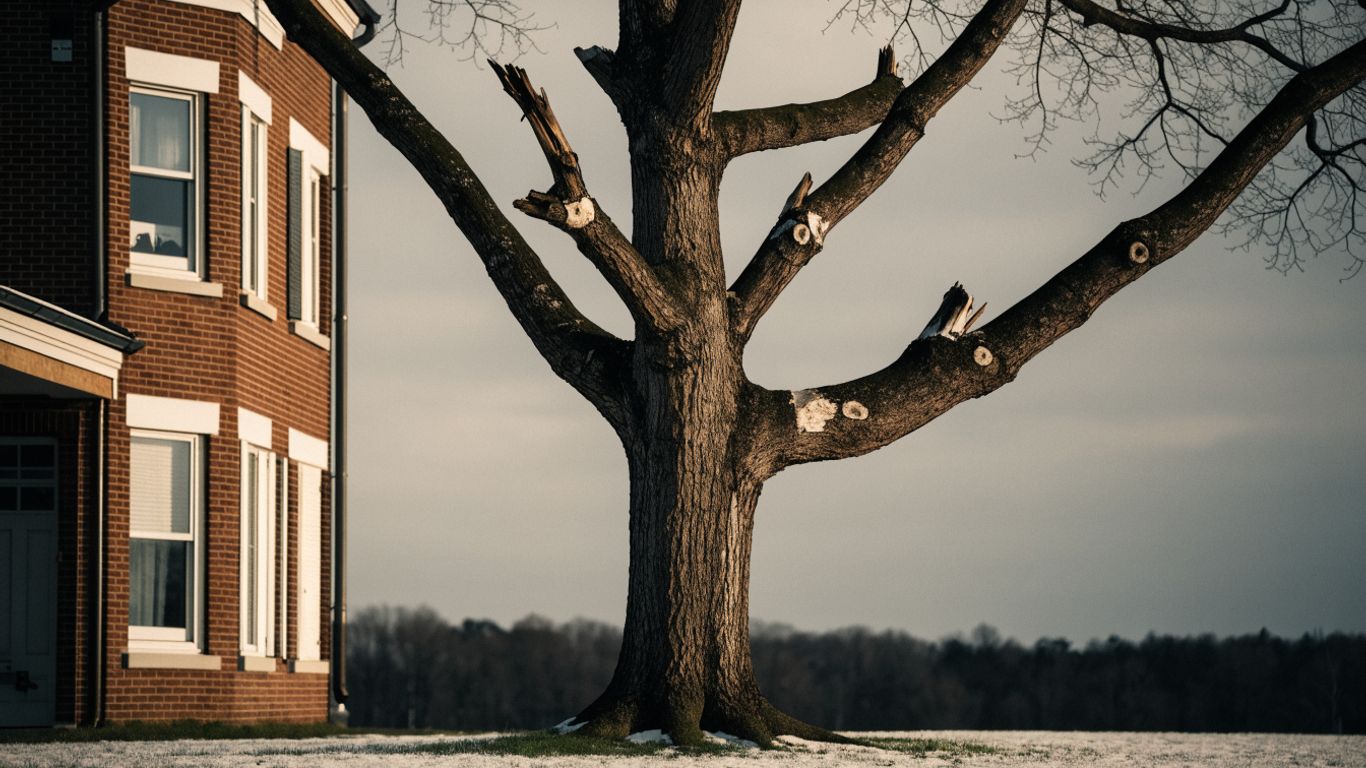
In those cases, professional tree removal in Ottawa followed by stump grinding is the safest route. Larger trees in Ottawa may need a permit, so check the Ottawa tree protection bylaw before any non-emergency removal.
Split Tree Repair Options Arborists Use
Split tree repair is a structural job. Arborists follow the ANSI A300 standard for supplemental support systems, which sets out how hardware is selected, sized, and installed. For most splits, the repair combines two or three of the methods below. You can see how the service works on the tree cabling and bracing.
Tree Bracing with Threaded Steel Rods
Bracing uses threaded steel rods installed through the trunk or union, secured with washers and nuts on each side. The rods hold the two sections together so they cannot spread apart or twist. On a fresh split, the arborist may first draw the sections back together before the rods go in. Several rods are often placed at different heights along the split, and the small drill holes are quickly covered by new growth on a healthy tree.
Bracing rods resist movement close to the split, so they are usually paired with a cable higher up to control the leverage from the canopy.
Tree Cabling to Support Weak Limbs
A support cable connects two stems high in the canopy, typically about two-thirds of the way from the union to the branch tips. It limits how far the stems can move apart in wind or under ice, which takes strain off the weak point below. Cables can be steel (static) or synthetic (dynamic), depending on the tree and how much movement it needs to keep.
A cable on its own does not hold a split closed. For an existing split, it works together with bracing rods. For a weak V-shaped union that has not split yet, a cable alone is often enough to reduce the risk.
Pruning to Reduce Weight on the Split
Careful pruning reduces the weight and wind resistance of the stems above the split, so less force reaches the damaged area. It also removes broken, hanging, or dead branches, which can be handled through deadwood removal. The goal is to remove only what is needed. Topping the tree or cutting off large limbs creates big wounds and weak regrowth.
A repaired tree also needs follow-up. Hardware, cable tension, and the split itself should be inspected regularly, usually once a year and after major storms. Do not hang swings, lights, or other loads from supported limbs, and call for a reassessment if the crack widens or the canopy starts to decline.
What to Do After Storm Damage Splits a Tree in Ottawa
A storm damaged tree in Ottawa can be dangerous even if it still looks upright. If you find a split tree trunk after a storm, follow these steps:
- Clear the fall zone. Keep people, pets, and vehicles away from the area the tree or a split section could reach, at least a distance equal to the tree’s height.
- Stay away from power lines. If a damaged tree is touching or near a line, do not approach it. Contact Hydro Ottawa or your local utility, and call 911 if lines are down or sparking. This guide to cutting trees near power lines explains why this work is left to qualified crews.
- Take photos from a safe distance. Record the split, the whole tree, and anything nearby it could hit, and note the date you found it.
- Do not climb, cut, or strap the tree. A split tree can shift without warning.
- Call an ISA Certified Arborist. If a section is hanging, moving, or resting on a building, request emergency tree removal.
Split Tree Repair Mistakes to Avoid
Well-meant quick fixes often make a split tree trunk harder to save. Avoid these common mistakes:
- Wrapping the trunk with straps, chains, or wire. Wraps hide movement and cut into the bark as the tree grows, which can girdle the trunk.
- Installing your own bolts or lag screws. Undersized or poorly placed hardware cannot carry the loads involved and creates new entry points for decay.
- Filling the crack with tar, foam, or sealant. Fillers trap moisture against the wood and do nothing to hold the sections together.
- Waiting for the next storm. Each wind or ice load can widen the split and reduce the chance of a successful repair.
- Cutting off one of the stems yourself. This leaves a very large wound and can send a heavy limb in an unexpected direction.
Get Your Split Tree Assessed by Advanced Tree Solutions
Advanced Tree Solutions is a locally owned tree care company that has served the National Capital Region since 2011, with ISA Certified Arborists and Tree Risk Assessment Qualified (TRAQ) staff on the team. The team assesses split and storm-damaged trees, installs cabling and bracing systems where a tree can be saved, and handles safe removal when it cannot, across Ottawa and nearby communities including Kanata, Barrhaven, Nepean, Stittsville, Manotick, Kemptville, and Arnprior.
If you have a split tree trunk in Ottawa or the surrounding area, the sooner it is assessed, the more options you are likely to have. Call 613-299-3150 or contact Advanced Tree Solutions to book an assessment.
Conclusion
A split tree trunk is not always the end of a tree. Partial splits in healthy trees with sound wood can often be saved with bracing rods, support cables, and careful pruning, while a trunk split in half, decay behind the crack, or a high-risk location usually points to removal. Whatever the damage, the safest first steps are the same: keep people clear, avoid DIY fixes, and have the tree assessed quickly, because splits tend to widen with every storm.
Advanced Tree Solutions is a locally owned tree care company that has served the National Capital Region since 2011, with ISA Certified Arborists and Tree Risk Assessment Qualified (TRAQ) staff on the team. The team assesses split and storm-damaged trees, installs cabling and bracing systems where a tree can be saved, and handles safe removal when it cannot, across Ottawa and nearby communities including Kanata, Barrhaven, Nepean, Stittsville, Manotick, Kemptville, and Arnprior.
If you have a split tree trunk in Ottawa or the surrounding area, the sooner it is assessed, the more options you are likely to have. Call Us contact Advanced Tree Solutions to book an assessment.
Frequently Asked Questions
Can I fix a split tree trunk myself?
Not safely, except for small split branches on young trees, which can be pruned off with a clean cut. Repairing a split tree trunk requires correctly sized rods and cables, precise drilling, and often work at height on a damaged tree that can shift without warning. Your role is to keep the area clear, take photos, and book an arborist quickly.
Should I wrap or bolt a split tree trunk?
Neither should be done as a DIY fix. Wrapping hides movement and can girdle the tree as it grows. Bolting only works when the hardware is the right size and is placed correctly, which is why arborists use threaded steel rods installed to the ANSI A300 standard, usually combined with a support cable higher in the canopy.
How soon should a split tree be repaired?
As soon as possible, ideally within days of finding it. Every wind or ice load can widen the split, and a fresh split is easier to close and brace than one that has been open for months. If the split is moving, a section is hanging, or the tree is over a home or driveway, treat it as an emergency and call the same day.
Will a split tree trunk heal on its own?
No. The two sides of a split never fuse back together. A healthy tree seals off the damaged wood and grows new layers around the wound, but the crack remains a permanent weak point. Without support, the split usually keeps opening under wind and ice loads, which is why bracing and cabling are used to hold it in place.
Is a split tree dangerous if it is still standing?
It can be. A tree that looks stable can fail suddenly when the next storm, ice load, or strong gust hits the weakened section. The risk is highest when the split is fresh or widening, when a large stem leans away from the crack, or when the tree stands over a home, driveway, or play area. Keep people clear and have it assessed before assuming it is safe.